Training Is a Starting Point, Not a Finish Line
When people ask what “trained” means in a working-line dog, they often imagine a finished product. They picture a dog that listens automatically, behaves perfectly, and requires little maintenance.
That image is appealing. It is also unrealistic.
In a working-line dog, training builds structure, communication, and clarity. It establishes commands, boundaries, expectations, and accountability. A trained dog understands what is being asked. It does not mean the dog will maintain that standard without reinforcement.
Training builds understanding. Ownership keeps it sharp.
A working-line German Shepherd or Doberman is bred with capability and drive. That capability must be guided consistently. Without structure, even a well-trained dog will test boundaries over time. This is not disobedience. It is instinct.
When we define “trained” for a working-line dog, we mean a strong foundation, not a permanent autopilot setting.
Controlled Training vs. Real-World Reliability
Another common misunderstanding about what trained means in a working-line dog involves environment.
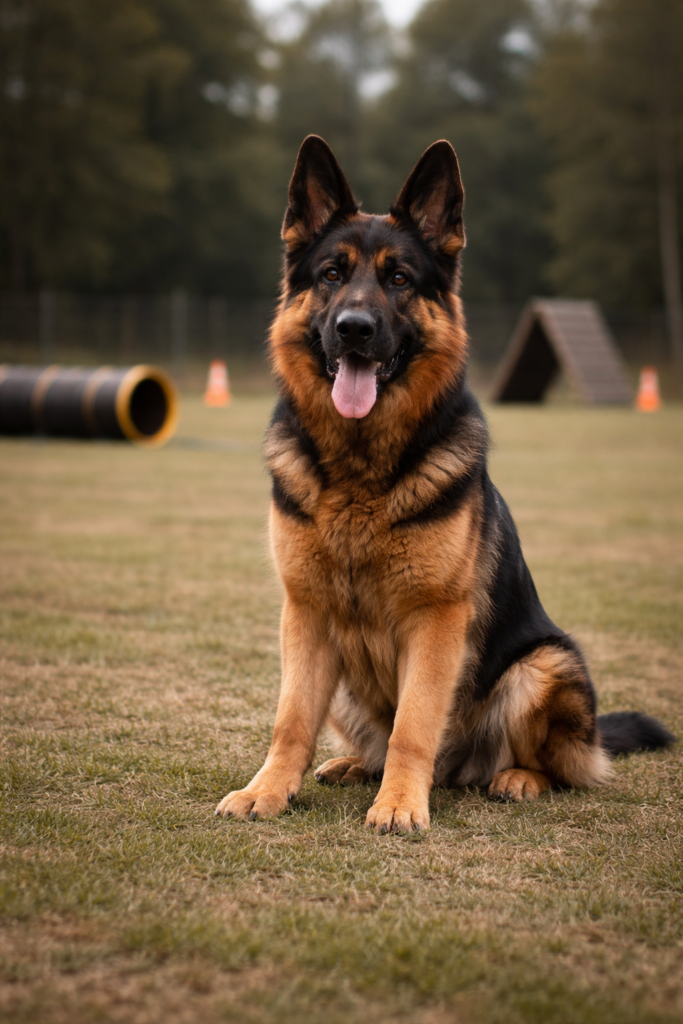
A dog can perform beautifully in a structured training field. The commands are clear. The setting is controlled. The distractions are intentional and measured.
Real life is different.
Real-world reliability means the dog responds:
- In unfamiliar locations
- Around new people
- Under environmental pressure
- In daily household routines
Training must transfer beyond the field.
That is why working-line dog training emphasizes exposure, repetition, and consistent expectations across multiple environments. Reliability is built through reinforcement in real situations, not just demonstration settings.
A trained dog should look stable and responsive in everyday life, not mechanical or overly stimulated.
The Owner’s Role After Placement
Understanding what trained means in a working-line dog also means understanding ownership responsibility.
A trained dog still requires:
- Clear daily structure
- Consistent handling
- Ongoing reinforcement
- Calm leadership
- Defined boundaries
Training does not eliminate the need for engagement. It makes engagement more productive.
When ownership becomes inconsistent, reliability weakens. When commands are optional, boundaries blur. Working-line dogs notice inconsistency quickly.
That is why placement conversations focus heavily on expectations. A dog may arrive trained, but long-term success depends on the environment it enters.
Structure Builds Confidence
Structure is not about control. It is about predictability.
Working-line dogs respond best when expectations remain steady. When routines are consistent, confidence increases. When leadership is calm and clear, stability follows.
Without structure, drive can turn into frustration. With structure, drive becomes capability.
Understanding what trained means in a working-line dog includes recognizing that training and structure work together. One supports the other.
A Working Relationship, Not a Product
Ultimately, what trained means in a working-line dog comes down to partnership.
Training creates a framework. Ownership maintains it. Communication keeps it strong.
Whether the dog is trained in advanced obedience or specialized protection work, the principle remains the same: clarity, consistency, and accountability produce long-term reliability.
A trained working-line dog is not a finished product. It is a capable partner with a strong foundation.
When expectations remain clear, that foundation holds. When structure fades, reliability fades with it.
That is the standard behind every dog we train.